
Contact nuri.uzunlar@sdsmt.edu to be waitlisted.
Sequence Stratigraphy Field Camp
Four semester credits
Not offered in 2026
Book Cliffs, Utah
$4, 895.00
$4,995.00
$300
$4, 895.00 Four Credits. Deposit $300 (required upon registration). Cost includes tuition, fees, food, lodging and transportation to field sites from Salt Lake City. Cost does not include airfare to Salt Lake. Students will be picked up and dropped off at Salt Lake City Airport.
Meeting details will be mailed to registered participants.
The Book Cliffs, Utah have become the premier locality globally for field teaching of sequence stratigraphy. Continuous, well-exposed and easily-accessible outcrops make it possible to analyze facies relationships of stratigraphic sequences in great detail, both in terms of lateral variation (systems tracts) and vertical stacking patterns (parasequences). Most significant clastic depositional systems are represented, including meandering, braided, and anastomosed fluvial; fluvial- and wave-dominated deltas; transgressive and regressive shorefaces; tidally-dominated estuaries; and “deep-water” mudstones. This makes the Book Cliffs an excellent classroom to study the interrelationship between eustatic and tectonic development of accommodation space and subsequent filling by clastic sediment.
The Book Cliffs region is often cited as an analog for subsurface exploration, particularly in foreland basins, and sequence stratigraphy has become one of the leading methods for correlating and mapping depositional packages, leading to significant discoveries of petroleum in fields that had been abandoned, as well as new discoveries. To that end, this course is directly applicable to the exploration, characterization, simulation, and development of petroleum reservoirs. Because of its impact on fluid migration and the importance of determining migratory paths for mineral-bearing solutions, groundwater flow, and tracing of contaminant migration, sequence stratigraphy is also becoming more widely applied to the fields of mining geology and hydrology. This course gives participants an opportunity to view sequence stratigraphic features directly in outcrop, giving a better perspective when making similar interpretations based on cores, logs, and seismic sections.
Exercises include measurement of stratigraphic sections, drafting of stratigraphic columns, correlation of columns, creation of regional cross sections, development of detailed outcrop facies maps, logging core, and completion of formal reports and oral presentations. Exercises become progressively more complex throughout the camp, with a final comprehensive/unifying project.
This course is designed as a capstone experience for junior- and senior-level undergraduate students majoring in geology, who have a basic understanding of depositional systems and stratigraphic principles but desire a stronger working knowledge of sequence stratigraphy through a hands-on field experience. In addition to enhancing a student’s knowledge of sequence stratigraphy, this camp is designed to help the student develop solid critical thinking, problem solving, and communication skills, as well as proper application of the scientific method.
Use multiple-working hypotheses to demonstrate the possibility of more than one reasonable interpretation for the same succession
Physical geology, historical geology, mineralogy, petrology, sedimentology, stratigraphy, and structural geology. Exceptions considered.
Field work will involve mapping remote areas and will include daily hikes of considerable length in rugged terrain.
Weather in the Book Cliffs during the month of June is likely to be dry and hot, though thunder storms are not unusual. Participants should be prepared for hot days (90 – 100° F / 32 – 38° C) and cool evenings (ave. 55° F / 13° C).
Lodging will be in a motel in the town of Green River, Utah
Color pencils I recommend these inexpensive ones (box of 72). Click Here .
A detailed equipment list will be provided before camp.
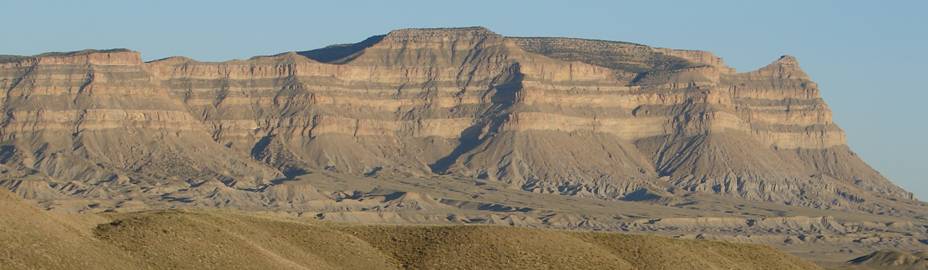
Example of a progradational parasequence set forming a highstand systems tract in the upper part of the Blackhawk Formation and overlying Castlegate Sandstone. Lateral facies changes in shoreface deposits can be seen from proximal (right) to distal (left). Locality is the Beckwith Plateau at the mouth of Woodside Canyon, Utah.
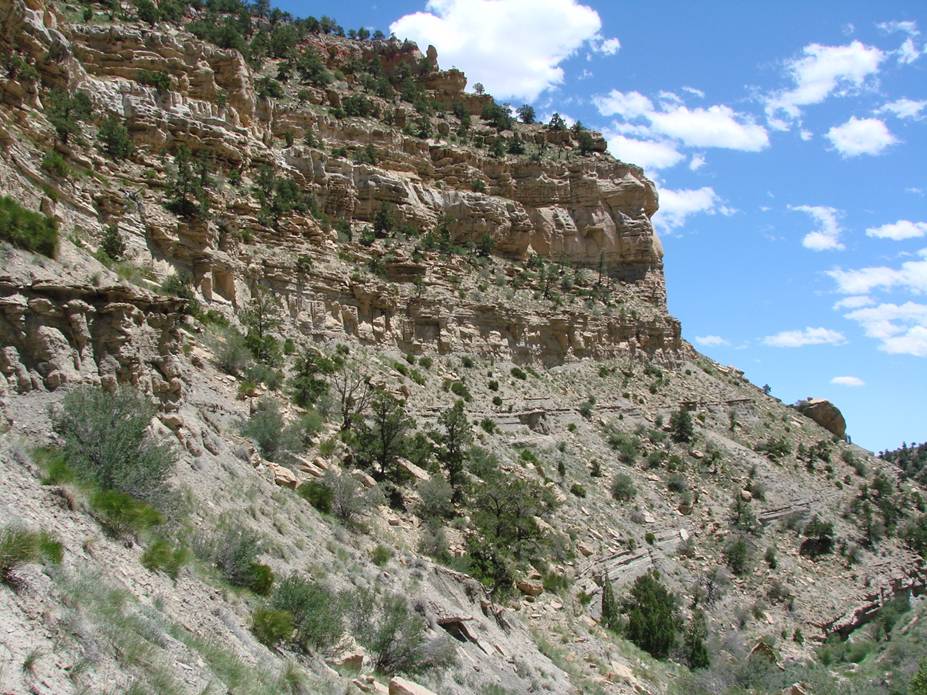
Middle portion of a complete depositional sequence in the Star Point and Blackhawk Formations at Gentile Wash, Utah
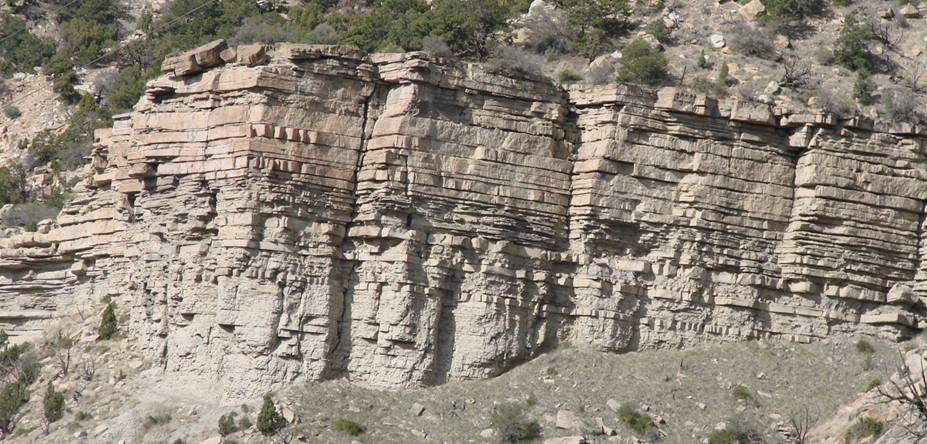
River-dominated deltaic deposits of the Panther Tongue Member, Star Point Formation north of Helper, Utah, deposited during a forced regression as part of a falling-stage/lowstand systems tract.
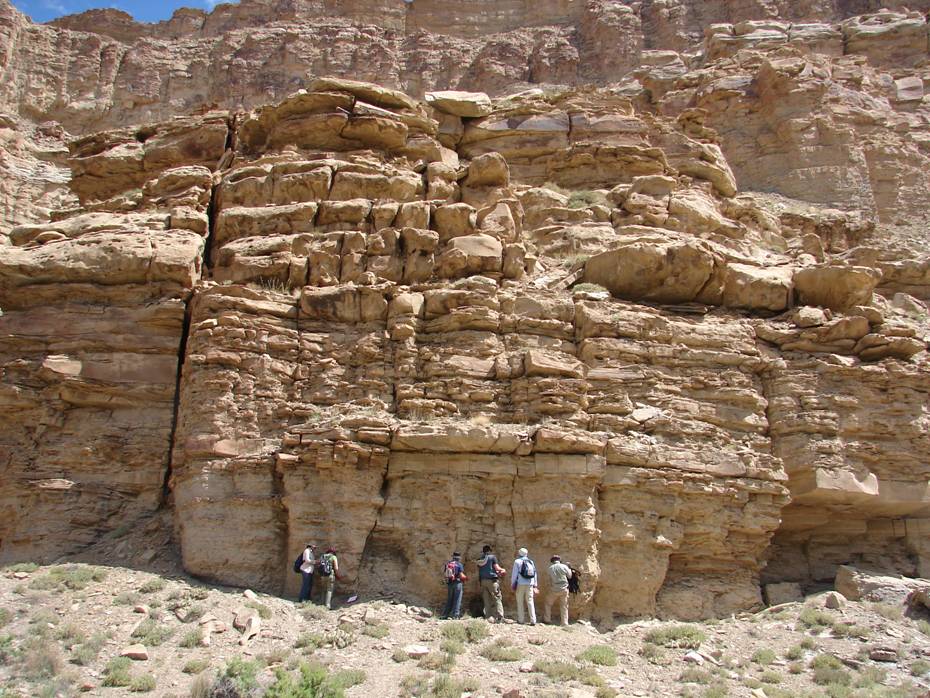
Wave-dominated deltaic deposits of the Kenilworth Member, Blackhawk Formation at Woodside Canyon, Utah, deposited during a highly progradational episode of a highstand systems tract.
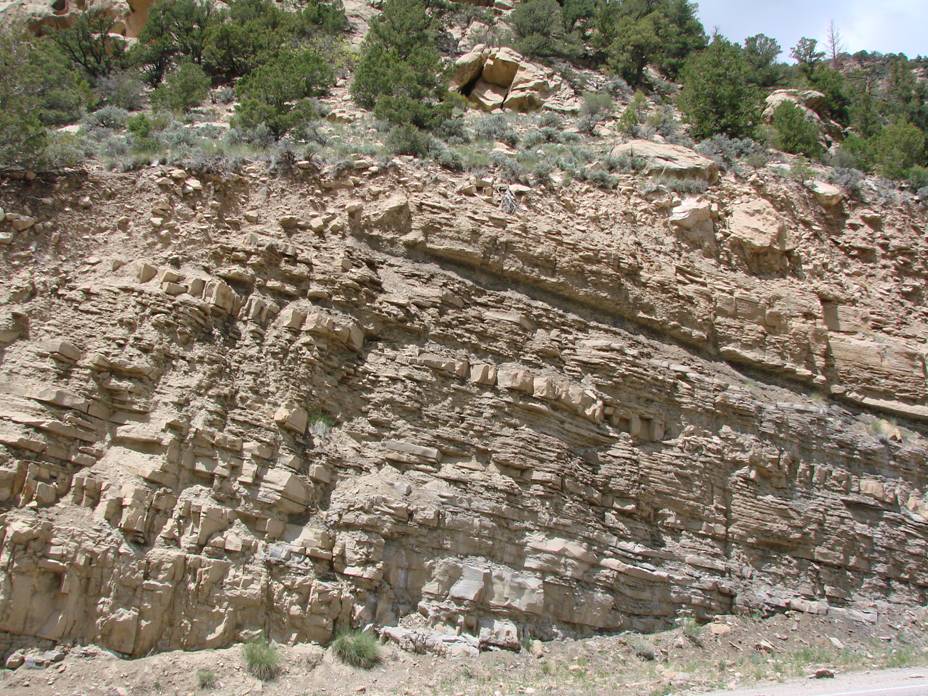
Tidally-influenced estuarine (incised valley fill) deposits of the Aberdeen Member, Blackhawk Formation in Soldier Canyon, Utah, deposited during marine transgression following a forced regression.
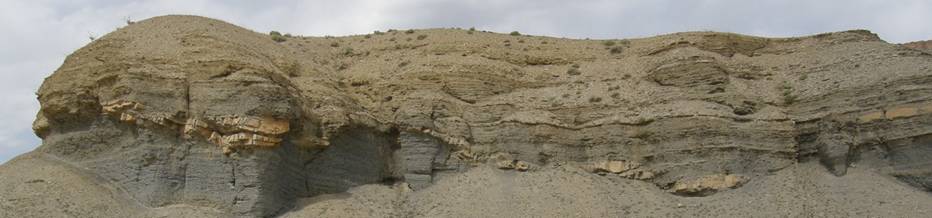
Possible bypass channels feeding the Prairie Canyon Member, Blackhawk Formation. Channels formed in offshore marine mudstones during a lowstand event, then back-filled with sediment during the subsequent base-level rise.
Dr. William W. Little, Course Coordinator/Instructor
W.W. Little Geological Consulting, LLC
208/201-6266
Dr. Nuri Uzunlar, Director, Black Hills Natural Sciences Field Station
Professor, Geology and Geological Engineering Department
South Dakota School of Mines and Technology
Office Phone: (605) 394 – 2494 ; Cell: (605) 431-1275