
Session Two – Six semester credits
June 22 – July 24, 2026
Application deadline: May 30, 2026
Contact nuri.uzunlar@sdsmt.edu to be waitlisted.
GEOL - 410 Field Geology
Six Semester Credits
June 22 - July 24, 2026
Rapid City, SD
June 22, 2026 at 8:00 AM
Meet at SD Mines
July 24, 2026
Students leave at 12:00 noon.
$5,495.00
$5,895.00
$300 is due at registration
May 30, 2026
Limited to 24 students
Two days of camping
$5,495.00 for consortium members and $5,895 non-consortium. Deposit of $300 is due at registration. Includes tuition, all fees, food and transportation from Rapid City. Students will stay in dorm setting in two in a room type of lodging. Two days of camping. Course is limited to 24 students. Details will be emailed to registrants 30 days prior.
Monday, June 22, at 8:00 AM – Meet at SD Mines. Lodging arrangements will be made for those arriving on Sunday, June 21. July 24 – end of camp – students leave at 12:00 noon.
Rapid City, SD
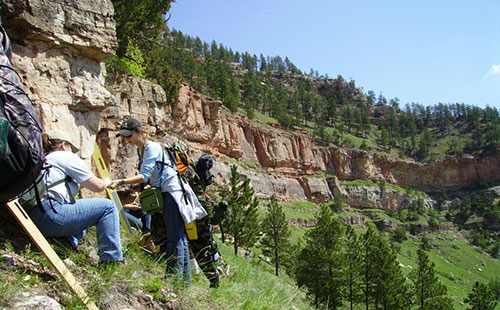
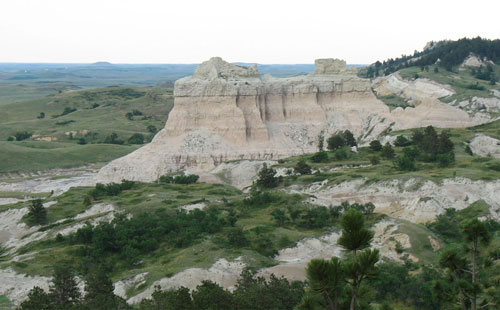
The scenic Black Hills of South Dakota and Wyoming provide the setting of world-class geology for the course. Students will map Precambrian metamorphic, Phanerozoic sedimentary and Tertiary igneous rocks to better understand the complex geologic evolution of the Black Hills uplift from the Trans-Hudson orogeny to the post-Laramide deposition sediments that make up the Badlands area east of the Black Hills as well as in the Slim Buttes area of northwestern South Dakota.
Students will measure, describe and correlate stratigraphic sections to gain familiarity with Paleozoic and Mesozoic formations of the Black Hills region. The weekly mapping projects, involving different rock types and undertaken at various scales, provide interesting geologic insight to the major stages of the Black Hills uplift. The second week project begins with the mapping of a structure with inclined sedimentary rocks. The third week project involves the mapping of igneous rocks and how they may have affected the overlying and surrounding rocks. The fourth week involves the mapping of metamorphic rocks and their complex deformation history. The fifth week involves the mapping of sedimentary rocks with complex structural/tectonic elements. These exercises will emphasize the preparation of stratigraphic columns in addition to geologic maps, structural cross sections and the completion of formal geologic reports.
Completion of junior year of study, Physical Geology, Mineralogy, Igneous/Metamorphic Petrology, Stratigraphy/Sedimentation and Structural Geology, or consent of the Director.
In addition to standard Brunton compasses, students will utilize GPS for detailed mapping using aerial photographs and topographic base maps. The skills and technical knowledge gained in this course are applicable to environmentally related problems in addition to practical applications in mineral resources and hydrogeology, for example.
Field work will involve working off-trail in semi-rugged to rugged terrain and may include hikes of some length. Students should be both physically and mentally prepared and comfortable with steep terrain.
Session 1: Late spring weather with a mix of sunny and rainy days with temperature ranges of highs from the 40s to 80s and lows from the 30s to 40s. Session 2: Summer weather with mostly sunny days with temperature ranges of highs from the 70s-80s to the 90s with typically low humidity and lows from the 60s to the 70s at night.
Lodging for the duration of the course will be at the SDSM&T dormitory in Rapid City, SD. Students will need to supply their own bedding (sheets, pillowcase, blanket for a single bed or sleeping bag as well as towels, wash cloth, etc.).
Books
Latest edition (1985)of Comptons “Geology in the Field” is required. Available on Amazon as hard cover or e-book ($19)
Brunton and GPS units.
Try borrowing a Brunton and a GPS unit from your department if available. If not it will be provided for you.
Field & Drafting (Metric for Turkey Camps and other international camps) can be purchased in the
SDSM&T Bookstore
geology hammer/pick
holster for hammer (optional but very useful;
10X hand lens (can be purchased at the Museum)
small field magnet
small acid bottle (we will furnish 10% HCl)
two engineer’s notebooks or other hard-covered field notebook (legal pads, spiral
notebooks, etc. are not suitable)
clipboard / map board
day pack
water bottles and//or hydration bladder/reservoir. 2-3 liters min.
pencils (3H, 4H, and 6H)
drafting pens (0 and 1 at a minimum; 00 and 2 are helpful; bring
refill of waterproof ink)
protractor (6-inch – an extra one may come in handy)
engineer’s scales (10 and 20 lines/inch; three sided scale with 10, 20, 30, 40,
50, and 60 scales are best) ( Metric only for Turkey and other international camps)
triangles (30-60o, 45o)(optional)
colored pencils (24 set recommended)
T-square (optional, but very useful)
drafting board (optional, but very useful)
graph paper (preferably 20 divisions/inch)
Field Clothing – prepare for all sorts of weather from wet and cold to very hot depending on which camp you are attending. Please read instructions on
the website for individual camp.
field pants (several pair)
field shirts (lightweight, long- and short-sleeved)
hiking boots (most important tool! – waterproof, ankle-high boots are best; an extra
pair would be a good idea – make sure they are broken in before field camp)
wool hiking socks or light socks with liners help prevent blisters (6-7 pair)
sweatshirt(s) or fleece pullower
warm jacket or sweater
windbreaker
rain gear (raincoat, and rainpants or gaiters)
hat (s) (rain or snow and sun protection), gloves
field vest (optional, but very useful)
Bedding – See specific camp info.
sheets, pillow, pillowcases, and blankets for a standard twin size bed, or sleeping bag for Rapid City based camps.
(nights will be cool or cold for earlier sessions)
Computers
A laptop or similar computer for preparing reports. Printers provided
Camping (for GEOL 410 – Black Hills Geology camp only, two nights only, probably fifth week)
sleeping bag
small tent is recommended
ground cloth, air mattress or foam pad
Other Personal Items
sunglasses
flashlight/head lamb
set of light clothing for town
light everyday shoes or moccasins for wearing inside Ranch A
swimming suit
towels, washcloths, toilet articles, laundry supplies
prescription/o.t.c medicines for seasonal allergies and poison ivy
insect repellent (optional)
sunburn lotion (at least SPF 15)
camera
binoculars
envelopes, stamps, etc.
favorite snacks.
Dr. Nuri Uzunlar, Director, Black Hills Natural Sciences Field Station
Professor, Geology and Geological Engineering Department
South Dakota School of Mines and Technology
Office Phone: (605) 394 – 2494 ; Cell: (605) 431-1275