
December 27, 2026 – January 12, 2027 – Three Credits
December 27, 2026 – January 17, 2027 – Four Credits
Application Deadline: June 1, 2026
Contact nuri.uzunlar@sdsmt.edu to be waitlisted.
Death Valley Field Camp
Three Semester Credits
Four Semester Credits
December 27, 2026 - January 12, 2027 - Three Credits December 27, 2026 - January 17, 2027 - Four Credits
Death Valley Region
December 27, 2026 at 2:00PM
Las Vegas
January 12 and 17, 2026
Drop off in Las Vegas before 11:00AM
$3,995.00
$4995.00
$300 is due at registration
June 1, 2026
Limited to 20 students
No Camping
$3,995.00 three credits and $4995.00 four credits. Deposit $300 (required upon registration). Cost includes tuition, fees, food, lodging and daily transportation to the sites. Cost does not include airfare to Las Vegas. Each session limited to 20 students.
Students will be picked up in Las Vegas at 2:00PM on December 27 and drive to Shoshone. We will drop everyone off in Las Vegas before 11:00 AM on January 12 and 17.
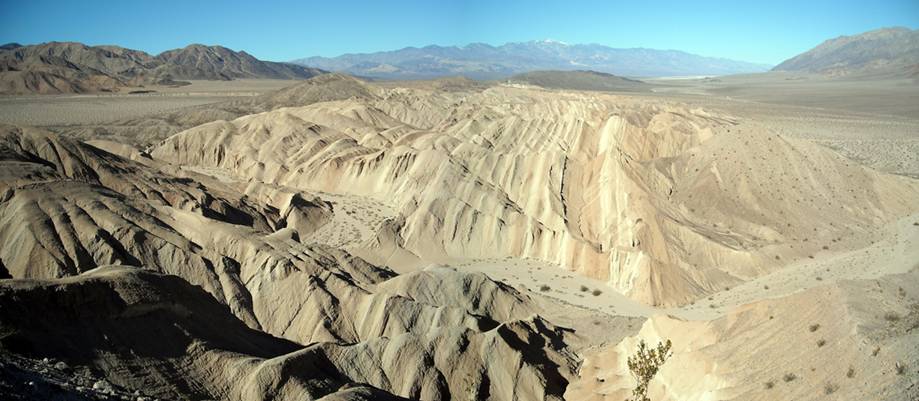
The Death Valley region is world renowned as a remarkable natural laboratory for geological field studies owing to its rich geologic and tectonic history and excellent rock exposures. Projects will investigate Proterozoic and Paleozoic stratigraphy, Basin and Range extensional faulting and synextensional volcanism, and neotectonic development of the right-lateral eastern California shear zone near the intersection of the Southern Death Valley and Garlock fault zones.
Students will develop skills for making geologic field observations and constructing geologic maps in the field. Students will learn techniques for measuring stratigraphic sections, collect structural data in the field, construct geologic cross sections, conduct simple structural analyses from the field data, and interpret geologic history from both stratigraphic and structural relations examined in the field, and regional tectonic relations that we will review as a group from the literature. Students will have the opportunity to learn mapping techniques using both topographic base maps and stereo imagery in the field.
We will be staying in dormitory style housing in Shoshone. The town of Shoshone has minimal conveniences although it does host a restaurant and general store. WiFi is available, but is not very fast.
Geology in the Field, 1985, Robert R. Compton. (Note: This text is now out of print, so please try to find one online if you don’t have it already).
Dr. Nuri Uzunlar, Director, Black Hills Natural Sciences Field Station
Professor, Geology and Geological Engineering Department
South Dakota School of Mines and Technology
Office Phone: (605) 394 – 2494 ; Cell: (605) 431-1275